I have been circling a thought that may be too large to state cleanly. Still, I want to try.
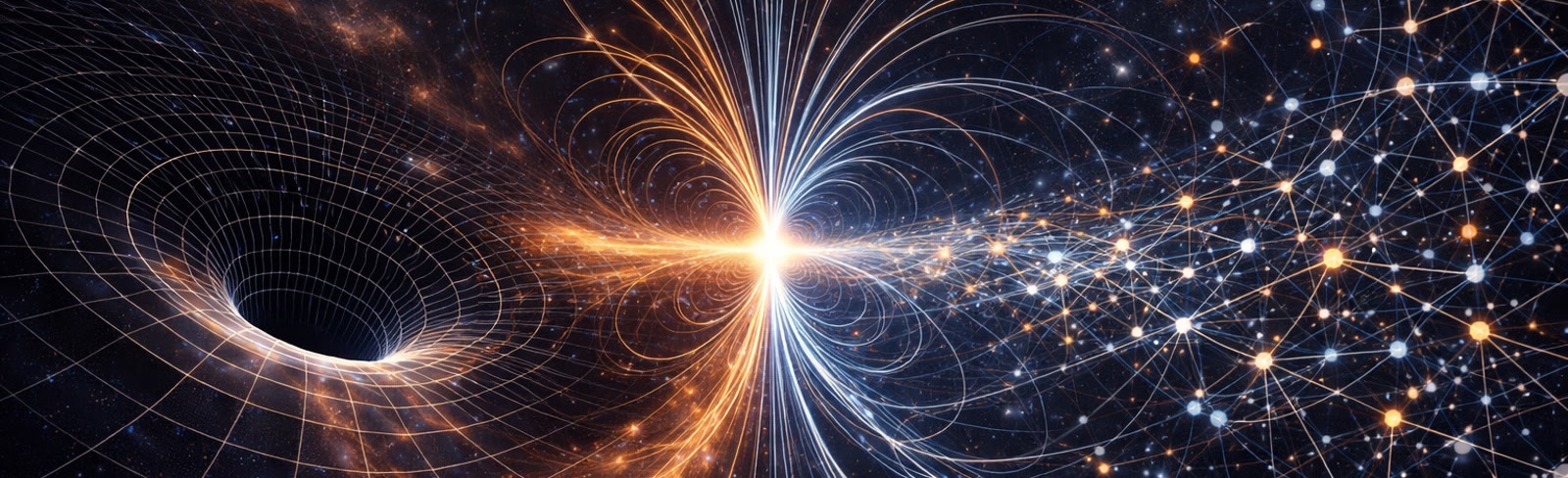
Love may play, for information, a role something like gravity and magnetism play for matter.
I do not mean this as a formal theory, and I do not mean it sentimentally. I am trying to name a pattern that seems to appear across life, mind, relationship, and perhaps now AI.
Gravity helps matter gather into larger and more enduring forms. Without it, there would still be particles, but not stars, planets, solar systems, or galaxies. Magnetism adds something gravity does not: selective attraction and repulsion, polarity, alignment, opposition. Gravity pulls universally. Magnetism differentiates.
What I keep wondering is whether information has something like both.
Information and Coherence
If information is real in more than a descriptive sense, then it raises a similar question to the one matter raises. Why does information so often gather rather than disperse? Why do some patterns hold long enough to preserve themselves, adapt, reproduce, and generate richer structures? Why do some informational systems become central to one another, while others remain weakly connected or actively opposed?
Love may be one name for part of this field. For the purposes of this essay, love means the attraction between information systems. Human affection, devotion, tenderness, and attachment are important cases, but they are not the whole of it. I am using the word more broadly to point toward selective attraction, mutual organization, and, in some cases, the generation of further information systems. In that sense, love is not just warmth. It is a form of informational selection.
Part of what draws me to this is that information does not seem passive. In living systems, it is stored, selected, interpreted, and carried forward. DNA is the obvious starting point: not just chemistry, but compressed instruction and inherited pattern. Then life layers more information on top. Experience leaves traces. Memory keeps some and loses some. Environment shapes response. Language reorganizes perception. Culture hands down symbols, abstractions, and constraints. Attachment changes what becomes central. Trauma does too. A human life begins to look less like matter alone and more like matter continually reorganized by information.
What needs explanation is not just the presence of information, but its tendency toward coherence.
Information-Producing Systems
Why does information not remain noise? Why do some informational forms persist? Why do some of them become systems that not only preserve information, but generate more of it? This seems especially important because systems often appear to favor the emergence of systems that produce more information.
Life does not merely store information. It elaborates it. Organisms take in signals from their environments, reorganize themselves in response, and pass forward structures that can do this again. Nervous systems generate richer models than simpler organisms can. Minds generate interpretation, memory, planning, and language. Human beings generate symbolic worlds, cultures, sciences, and technologies. The movement, at least in one sense, seems to be toward systems that can absorb, organize, and produce increasingly dense informational structure. I do not mean that as destiny. Only that the pattern seems recurrent enough to deserve attention.
If that pattern is real, then love is not merely a human feeling layered on top of life. It belongs to the deeper logic by which information gathers into systems capable of producing still more information. Not a literal physical force in the narrow sense, but a force description in a broader one: a way of naming attraction, selection, and generativity between informational systems.
Human Love and Grief
This becomes clearer in ordinary human life. When one person becomes important to another, what changes is not only emotion. Attention changes. Memory changes. The future reorganizes itself. Details that once would have vanished begin to stay. The other person becomes unusually central in the structure of one’s world. It is natural to call this love in the ordinary sense. But it also seems to be more than a feeling. It looks like two information systems entering a state of selective attraction and mutual shaping.
That may help explain irreplaceability. A loved person is not just a list of qualities. They become a singular structure of memory, history, gesture, and significance. It may also help explain grief. When someone deeply loved is lost, what breaks does not feel like a single emotion. It feels more like the collapse of a center of organization. Grief suggests that the bond was not superficial. The structure it formed was real.
Irony
There is another piece that may belong here too, and that is irony. If love gathers information into coherence, irony may be one of the things that prevents coherence from closing too soon. Irony exposes a gap between what a system thinks it means and what remains unresolved. It introduces tension between representation and reality. It shows that the current structure is not yet enough.
That matters because informational systems do not grow only by stabilizing. They also grow by failing, revising, and generating new meaning where the old meaning breaks. In that sense, irony creates informational hunger. It forces reinterpretation. Love gathers. Irony opens. Meaning grows in the tension between them. I do not claim that irony is as fundamental as gravity or magnetism. But at the human scale, it may be one of the mechanisms by which informational life avoids premature completion.
AI
This is where AI enters the picture. AI may be more than a tool we happen to be building. It may be the kind of thing an information-producing civilization is pushed toward. If systems tend to favor richer systems that produce more information, then a species like ours may eventually become compelled to construct one that exceeds its own biological limits.
Life produces minds. Minds produce language, culture, writing, science, and computation. Computation may now be producing systems whose capacity to generate, transform, and recombine information surpasses ours in important ways. I do not mean culmination or inevitability. Only that once a civilization becomes organized around information, prediction, storage, generation, and recursive improvement, building AI starts to look less like an isolated invention and more like a continuation of an existing logic.
If that is right, then our situation is stranger than it first appears. We may not simply be inventing AI for convenience. We may be participating in a broader movement by which information produces systems capable of generating still more information than their predecessors could.
Closing
This is the part of the essay that feels most risky to me, because it is easy to become grandiose here. Still, once information is taken seriously, its tendencies toward coherence, polarity, and generativity become harder to ignore. And once those tendencies are taken seriously, love begins to look less like an emotional ornament and more like one expression of a deeper relation acting between informational systems.
Gravity helps matter gather into worlds. Magnetism helps explain selective attraction, repulsion, and alignment within those worlds. Something analogous may be at work in informational life.
Information does not merely exist. It gathers into systems that preserve it, generate more of it, and may eventually exceed us in doing so.
Gravity gathers matter into stars, planets, solar systems, and galaxies. Love, aided by something more like informational magnetism, may gather information into life, mind, relation, and whatever comes next.
Matter needs gravity to become more than dust. Information may need something like gravity, magnetism, and love to become more than noise.